Professor Stephen Hong Sohn accepted a job offer to work at Fordham in January of 2020. Of course, by March 2020, the nation was in lockdown, leaving Sohn to spend his first year teaching from home in California. Within his enclosed time at home, Sohn found salvation in books. Ironically, he found the most escape with the realist novels that contained mundane moments such as going to the grocery store and running into familiar faces—aspects of daily life that the pandemic restricted almost entirely. Additionally, Sohn found himself escaping into a multitude of books with reality-defying aspects which made him begin to question what these speculative novels were attempting to do. What could imagining other ways—that were not limited to reality—of being produce? What aspects of our realities and histories can they expose?
Alongside the health horrors of the pandemic, racial violence against Asian Americans was on the rise. In his book, Sohn writes, “While we might think we have moved beyond such limited perceptions of the racialized subject, 2020 saw an incredible rise in anti-Asian sentiment, as COVID-19 became rebranded as the China virus” (1). In relation to these hateful attitudes raising to make Asian Americans the scapegoat, speculative Asian American fiction grew exponentially. Speculative fiction is an umbrella term, or as Sohn states in the book, a “catchall phrase” that includes multiple subgenres. Oftentimes, the subgenres within speculative fiction have been looked down upon, or not taken seriously as a literary field. Sohn expresses that, “The tendency is to think about genre fictions as a consumable low-brow object.” But through the main argument of the book, Sohn wants his readers to understand Asian American speculative fictions as “a socially conscious body of literature.” During his reading spree in COVID lockdown, Sohn found that “the experience of being an embodied Asian American impacted how I was reading about literature and what I wanted to read.” Thus, the seed of Sohn's newest book, Asian Ameritopias: Asian American Speculative Fictions, was planted.
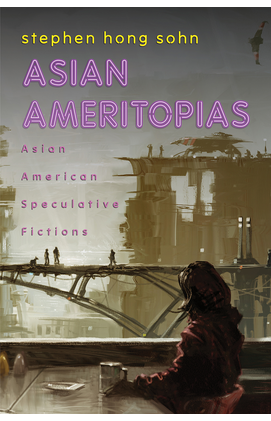
As stated earlier, the intersection between speculative fiction and Asian American literature has grown drastically in recent years. Because of the growing numbers, Sohn is by no means attempting to write on all Asian American speculative fictions or attempting to reformulate them into a clean mold. But rather this book is focused on Asian American speculative literature that deserves scholarly attention and has not received it. The book is split into two main sections: the first focusing on supernatural horror and fantasy, and the second covering science fiction that engages with issues of race. Sohn defines the ghostopia as composed of “a combination of living and dead characters who together gesture to the possibility of social change that is informed by the excavation of Asian American history” (28). Sohn believes that, “The reason why ghosts are such a useful tool is because they harbor stories, often about distant paths, that living people don’t have. So it becomes a useful device for thinking about histories that need to be excavated that have been lost.” He explains that there’s a social justice aspect to writing about ghosts “because people need to learn about their background to be informed about why they are experiencing the things that they are.” Specifically, Sohn is questioning how the use of ghosts in these speculative books provides, “a better understanding of history as an Asian American.”
Despite the word “Ameriatopia” in the title, Sohn is not only focusing on positive utopias. He says “Asian Ameritopians can also be dystopian as well in the sense that they address a certain social ill that needs to be confronted. So, I think the actual dystopian component of this book is in some ways really important, especially given everything we’re fighting for right now.” Sohn was finishing this book before the 2024 election, meaning that since then far-right politics have gained even more power with Trump’s re-election. While reflecting back on what he had learned throughout the editing and revising process of the past few years, Sohn realizes that “the contemporary moment really pushes scholarship in directions that are unexpected based on the historical events that are happening right underneath your feet.” Within Asian Ameritopias, Sohn asks how Asian Americans have imagined and are creating alternative ways of being through the supergenre of speculative fiction.