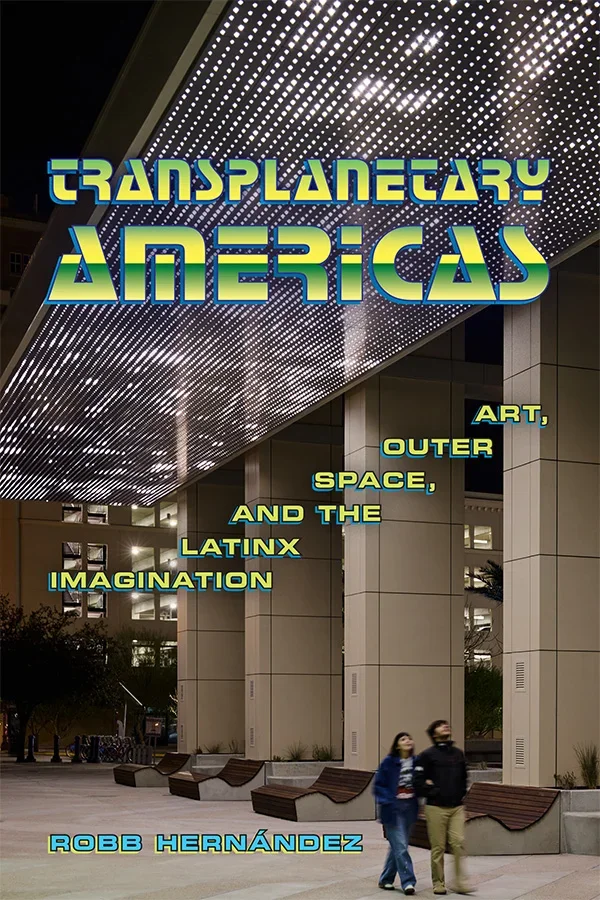
Professor Robb Hernández Urges His Readers to “Think Vertically” With New Book: Transplanetary Americas: Art, Outer Space, and the Latinx Imagination
Professor Robb Hernández is part of the English department, but his research interests span multiple fields including Latinx studies, art history, fashion studies, performance studies, queer studies, and more. This year, Hernández is publishing his newest book, Transplanetary Americas: Art, Outer Space, and the Latinx Imagination. The book dives into how Latinx artists have “turned vertically” and looked to space to imagine different worlds and new ways of being. Hernández demonstrates how the artists of his focus are not “replicating first-world science” with a colonial attitude towards space, but rather thinking of how we as humans inhabit the universe and can work with it, rather than attempt to contain it.
The roots of this project began in 2013 when Hernández was curating Mundos Alternos: Art and Science Fiction in the Americas that was part of Getty Museum’s Pacific Standard Time LA/LA Initiative. From 2013 through 2017 Hernández was able to travel and research, providing him with numerous opportunities to interact with Latinx creatives. Some of these artists specifically had science fiction inspirations, but Hernández noticed that almost all of the artists he was working with were asking speculative questions. Once Mundos Alternos opened in 2017 at University of California Riverside ARTSblock, he began gathering the names and suggestions of artists to research. Hernández states that during the show and the following research he noticed “the ways that the space race, astronomy, planetary science, or even re-visiting an astronomical archive started to predominate in their [Latinx artists] creativity,” which “helped [him] develop the threads.” In the book, Hernández elaborates on how Latinos were pushed to the background in the Cold War and during the Space Race; he wondered why there was not a great deal of science fiction in Latinx literature during this era of space exploration, but when Hernández turned to the visual arts he found the abundance of planetary speculation in that archive. He encourages other Latinx science fiction and speculative artists “not just to read our genre, but to see our genre.”
Although a main focus of the work is dedicated to the time of the Cold War, Hernández reaches back to ancient times and ends by jumping forwards to the space race of the present. While reflecting on what he learned while writing the book, Hernández said that he is amazed “how in our everyday lives, whether I am on campus, in the subway, or even in the airport, how often I see people looking down and digging into their phones for meaning.” To Hernández, the simple act of looking up, of turning vertically, can be a daringly important cultural and political gesture. Hernández states, “When we begin to look up, we think of the granularity of our humanity now and how we belong to an infinite universe … connecting to something higher and grander, something more ancient than we are.” Hernández explains that it has preoccupied Latinx artists for centuries—from ancient Mesoamerica, to Mexican revolutionaries in 1910 who saw a comet and believed it was a sign of both travesty and possibility, all the way to the contemporary artists featured in the book. Hernández asks us to find the time to look away from the ground, to make time to look up and imagine.