100 Tries: To Live Deep, An Interview
What does it mean to live deeply, not someday, but right now, in the everyday acts of reaching out, showing up, and trying again? In Spring 2026, two Fordham English majors, Sophie Maselli and Adithi Vimalanathan, took on a semester-long challenge of 100 Tries: one hundred deliberate attempts at opportunities and dares that scared them, stretched them, or simply caught their curiosity. Both blew past 100. In this interview, Sophie and Adithi share what they discovered about failure, momentum, and the surprising ways trying becomes a way of living vibrantly.
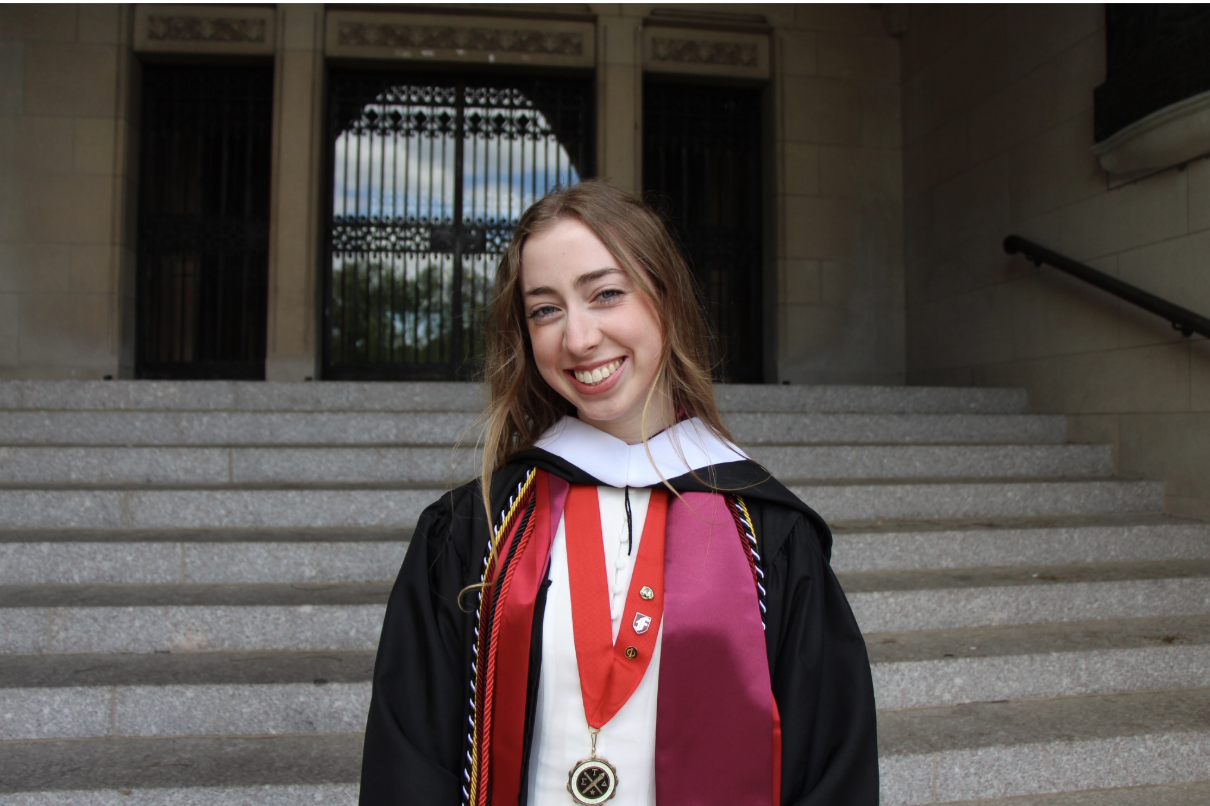
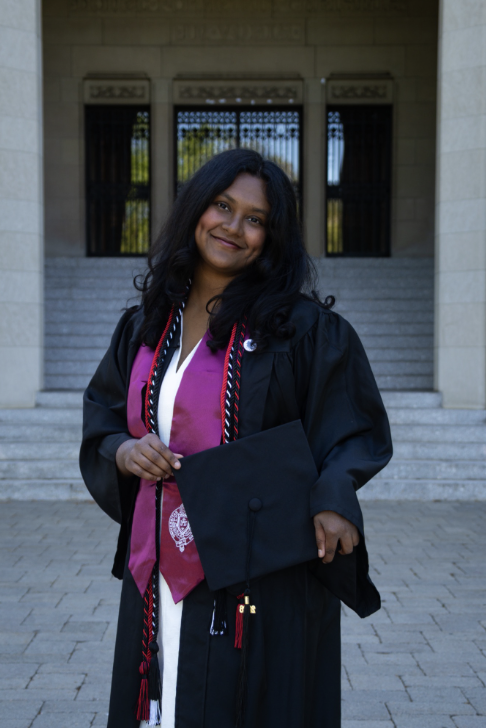
Walk us through your 100 Tries experience. Highs, lows, takeaways. What did you learn that you didn't expect to learn?
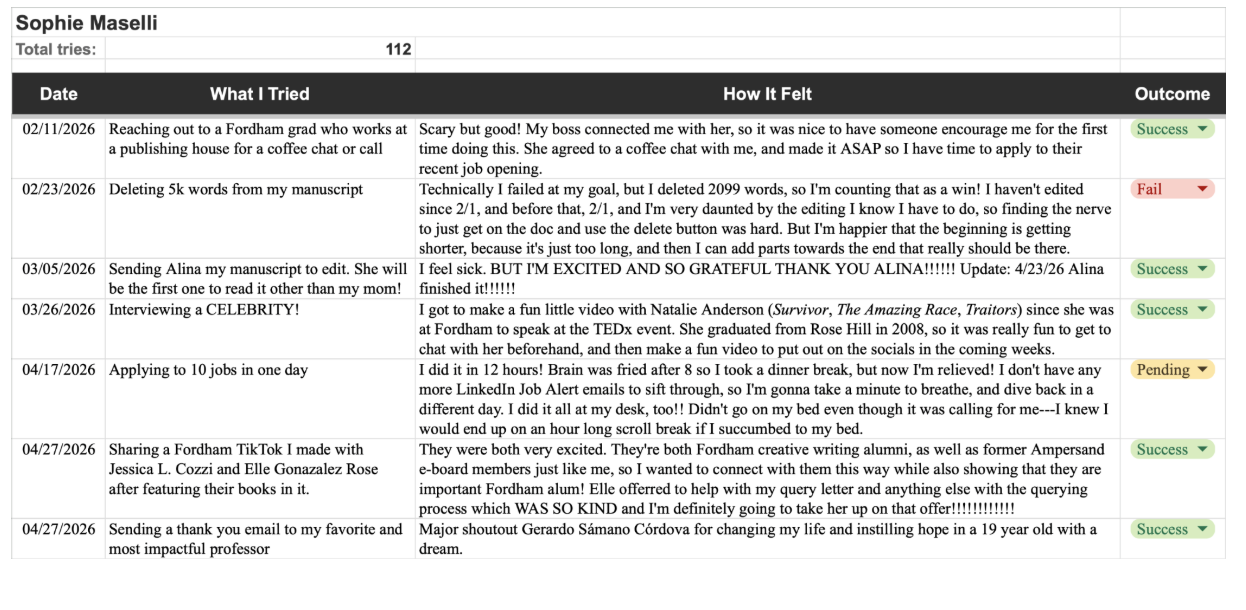
SM: When this optional assignment was presented, I immediately knew that I wanted to partake in it. I was overtly aware of the fact that it was my last semester at Fordham, and my last months living in New York City for a while. Thus, I knew that I could use this challenge as an excuse to take advantage of everything Fordham and New York City had to offer in my final months here. Some highs were that I had coffee chats, got a job interview, my manuscript was read over and given advice by a peer, and my query letter was read over by a published author! A notable low was one of the first tries I did: messaging one of my favorite Broadway actors for Broadway logistics. She never responded, which was disappointing, but oh well. I had put probably an hour into crafting my message, too. What I learned through this was that no matter how much time or anxiety I put into something, it could always fall through. Trying more generates more positive outcomes.
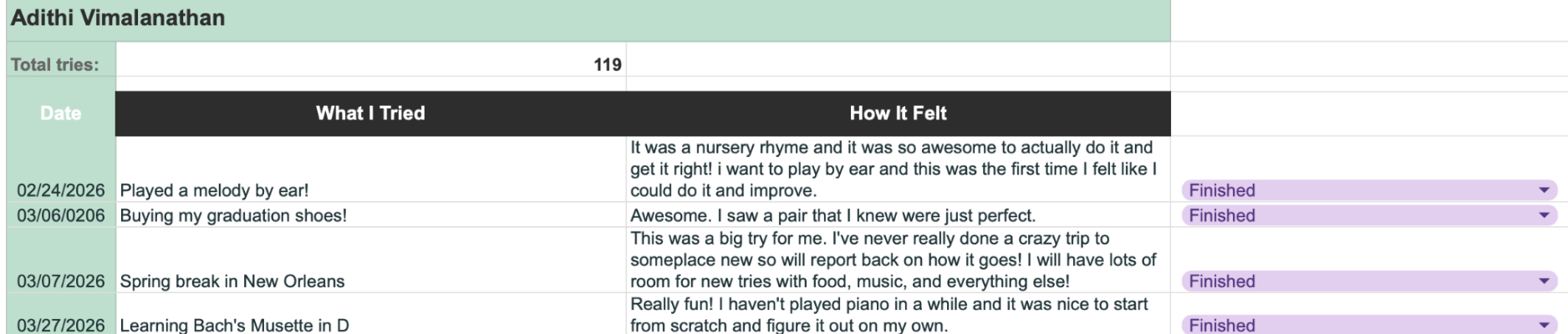
AV: I’ve always been someone who wants to do it all, but figuring out the steps has always taken me a minute. I took on 100 Tries as a way to challenge myself to actually do the things I wanted to and to cultivate a stronger ‘why not?’ mentality in my everyday. I got better at picking up the phone, sending emails, and reaching out when I saw something I was interested in, whether it was a photography opportunity or a job posting. This semester, I photographed a concert at Madison Square Garden and started producing video as a freelancer. Not all my tries were as fun, though. I tried to reframe some tasks like applications as ‘challenges’, trying to get through several in one sitting. The challenge certainly didn’t make it more fun, but it did push what I thought was possible and gave me a sense of progress.
Describe a specific try that was very challenging for you. What did this shift for you?
SM: The try that was most difficult for me was sending my manuscript to a classmate. I’ve been working on it since the beginning of my sophomore year, and thought I’ve workshopped various scenes in classes and through the VisionQuest fellowship, no one (other than my mom) had read the whole thing through. So to send those 99,000 words over to one of my peers was really nerve wracking because it was so vulnerable. But after I did this, I felt much more comfortable sharing my work with other creative writing students. I shared my manuscript with four other students who had offered to read it. It’s the larger hurdles that make the smaller ones feel like walking.
AV: I went biking for the first time since I was little. One of my friends invited me to come to Governor’s Island over Easter break to bike, and I said I’d give it a shot, but was not incredibly certain it was going to work out. It turned out we were both relearning, and she was nervous about it like me. The best part of that situation was that even though we were both nervous, we felt safe sharing that and doing a new thing with each other. People that encourage you and that you feel safe enough to make mistakes around make the world feel really open. Plus, we ended up biking around the whole island!
Did you notice a change in how you approached the tries over time? Did try #70 feel different from try #10, and if so, how?
SM: Not really! My goal throughout remained the same: try new things and benefit and grow from them. I would say that the only difference was that once I ripped the bandaid off with some harder tries, the others felt easier.
AV: I spent a lot of time this semester thinking about my direction after graduation. As I got more clarity and got more inventive with possible futures, I aligned my tries more strongly to explore these paths. But not every try was goal-centered. I believe in spontaneity and being truly open to things around you, and strengthening an attitude of trying in my day to day helped me honor those values.
What did you learn about your relationship to failure, discomfort, and what you thought was possible for you?
SM: At first, I wasn’t putting things on the spreadsheet that I had failed at. The mindset shifted when I realized that I had still tried, still put effort in, and should recognize that. I had set a goal over President’s Day weekend to delete 5,000 words from my manuscript, and I didn’t even delete one. I tried again a different weekend, and was over 1,000 words short of my goal. Still, it was something that I tried. Sometimes, failures are just smaller successes.
AV: The tries which I thought would be really stressful just weren’t, and realizing this helped me stop overthinking things. Wanting to do something is reason enough to try, and fearing a possible bad outcome is a poor reason to hold yourself back.
Is there a connection between what we do in an English class (reading closely, taking risks on the page, revising) and what 100 Tries asks of you in your life?
SM: Totally! In an English class, we revise our papers. If I failed at a try, sometimes I would try another time and improve. Writing about why I tried something and how it made me feel allowed me to close read myself and learn more about why a certain try was impactful, and why I did it.
AV: With 100 Tries, I looked at my own trajectories and considered them closely. I wondered where I could push forward and where I could pull back, and crafted it like I would a creative work. By trying, I made learning a habit by appreciating and getting close to what I did not know.
What advice would you give to students or alums thinking about taking on their own 100 Tries?
SM: Format it in the way that works best for you! I made a drop down feature on mine to track the outcome of the try. I feel most accomplished whenever I check something off a list, so I made a drop down feature that has the options of “Success,” “Failure,” and “Pending” if the outcome hadn’t occurred yet. Also, don’t be afraid to celebrate the little things, because they’re just as important as the big things, and will keep you going. All you need is momentum!
AV: It becomes second nature. The more you make a habit of trying, the more you automatically do it without thinking. Sometimes I’d sit down to log one try and realize that I had done way more things that I was initially nervous about, was outside of my comfort zone, or had no experience with. I came up with new ways of solving problems and saw the world as more within my reach.
Would you participate in another call for 100 Tries? If so, how would you approach this, knowing what you know now?
SM: Absolutely! I’m a big fan of spreadsheets and lists, so I definitely would use the drop down feature again to note whether the try was a success, failure, or if the outcome was still pending. A lot of my tries revolved around doing things at Fordham or applying to jobs, so I’m curious as to what it would look like when I’m more established.
AV: Most definitely! I would make it even more of a daily habit and give myself a couple avenues to be adventurous about, like new foods to cook or places to see. I’d make more plans, too. I really liked planning out my tries early in the week because it gave me something to look forward to.
What's next for you after Fordham? What would you want English majors to know about building a life post-Fordham?
SM: What’s next for me is a career in publishing or marketing and social media. And while I do that, I’ll be querying my novel in the hopes of getting signed with an agent sometime this year, and then on the path to publication! This capstone class allowed me to focus on the bigger picture of my life rather than just zeroing in on this one goal that I’ve been working towards for the past eight or so years. The English major offers so many different paths when drawing that blueprint of building a life post-Fordham.
AV: I’ll find out soon! I’d share what’s worked for me: be around people who affirm and amplify your truest self and all your possibilities. Let go of a need to know what’s next. Follow your curiosities with conviction. Be relentlessly open to everything, no matter how big, no matter how small.
