By Maggie Garza
On Monday, Oct. 19, Fordham’s Lincoln Center campus hosted an event with Korean poet Lee Seong-bok and translator Anton Hur, who translated Lee’s poetry collection “That Summer’s End,” published Aug. 4, 2026. Both writers were in conversation with Fordham English professor Dr. Sneha Khaund, who moderated the event. The discussion was largely focused on the relationship between poetry and translation, as well as language and identity.
Dr. Khaund currently teaches an English course at Fordham titled Texts and Contexts: Global Englishes, which is centered around authors who are from countries where English is not the predominant language, but has taken root due to colonization or other global influences. The course is particularly geared toward understanding how these authors have made English their own, rejected standard forms of English or even rejected English itself through their writing. It is worth understanding what happens when a text written in another language is translated into English. What are the implications of translating something into English, both for the author and for the text, and what gets lost in translation?
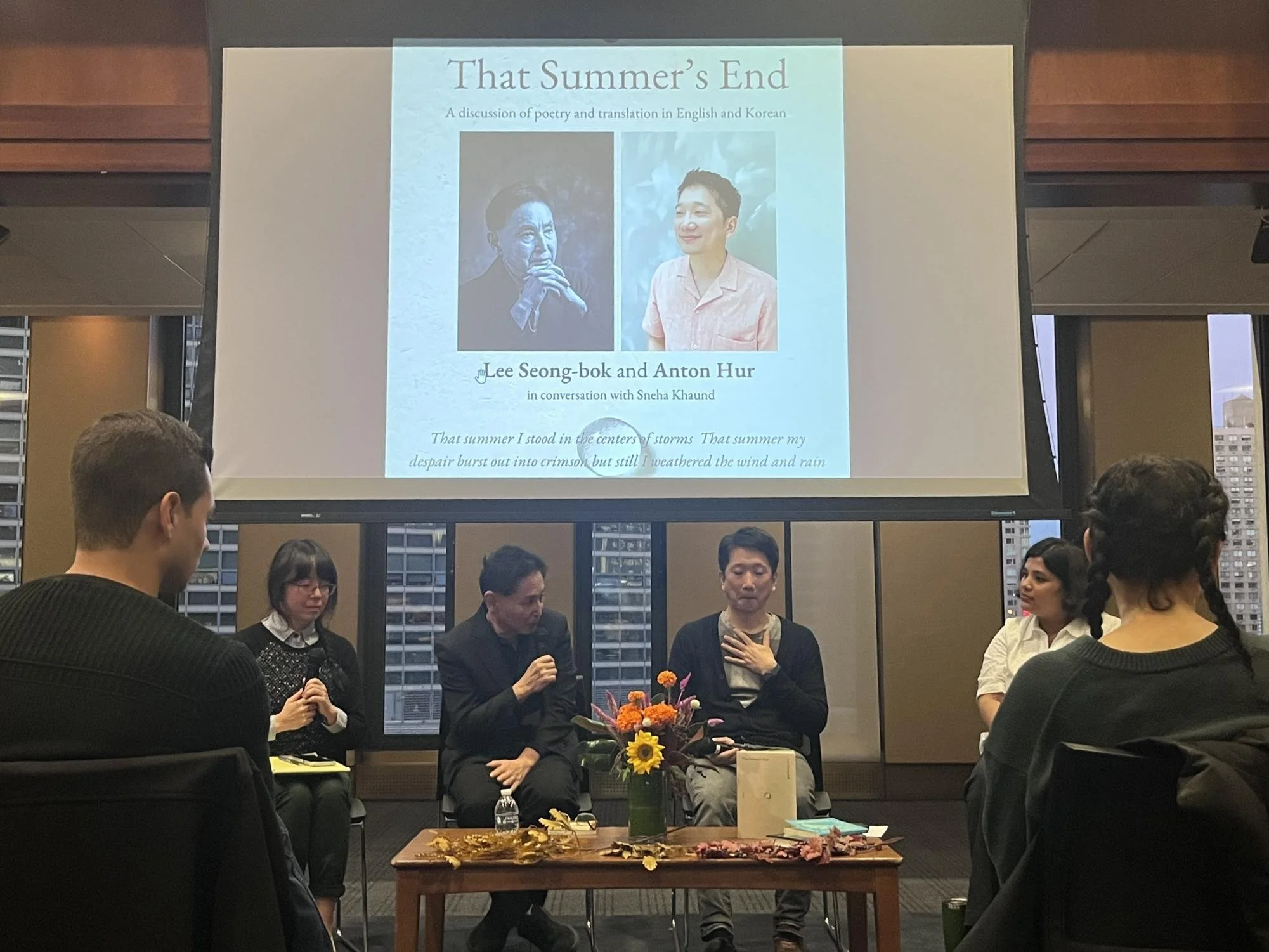
On Oct. 19, Fordham Lincoln Center hosted poet Lee Seong-bok to discuss “That Summer’s End,” his collection of 106 poems. (Photograph by Maggie Garza).
“That Summer’s End” was originally written in Korean and translated into English. It consists of 106 poems that focus on different aspects of nature and our surroundings, which Lee uses as mediums for self-reflection and contemplation. Through sequences of poems, Lee insists that the reader not seek answers to their questions but rather revel in the quiet unknown. The poems are vulnerable but avoid self-consciousness, and are centered around themes such as youth, love, fear, family, grief, old age and impermanence. They are inspired by Seon Buddhism, or the Korean tradition of Zen Buddhism, which focuses on meditation and understanding one’s true nature.
Additionally, Lee teaches French literature, and his poems are influenced by French symbolism, which focuses on the interior, specifically emotion and spirituality.
One of the most notable aspects of Lee’s poetry is the sparseness of the words used in the poems. Lee said that poems are “nothing less or more than making gaps” and that the “essence of poetry [lies in] what is not said.” Hur agreed with this sentiment, especially when it comes to translation, which he described as “experimenting with what [he] can leave behind,” in terms of words or phrases. This is something that he has become more comfortable with, arguing that “not everything can or should be translated” and that although it makes him sad to leave certain material out of the translation, he has come to find that “what you leave behind is the poetry.”
A similar melancholic experience follows Lee’s work, even though he is not translating it. “That Summer’s End” largely examines sorrow and grief, though towards the end of the collection there is a transition to joy. Lee commits himself to what he calls an “ethics” of poetry, meaning that he is committed to expressing all of life’s sadness and vulnerability through his poems as a way of being honest with himself and the reader. As a poet and teacher, he sees himself as a “provider” and views this commitment as a “promise” to himself.
Similarly, Hur spoke of a cathartic experience when displaying this form of honesty, which he refers to as “the productivity of melancholy.” It is when he writes from this vulnerability and sense of melancholy that he feels his work is most effective.
In addition to the emotional experience of translation, Hur described a physical relationship that exists when he is translating a text. He said that he translates from his ribcage and uses his body as an echo chamber, and that the sound that comes out is the translation.
A sense of trust, respect and care was deeply present between Lee and Hur throughout the conversation, and Khaund’s moderation of the discussion provided a safe space for this level of vulnerability.
However, Hur explained that this relationship is rare between authors and translators, who are often pitted against each other during the publishing process. Hur described how translators are often “trampled on” by the publishing industry, and that there is a focus on the “actual” or original author. For this reason, he argued that translators need better protections in the industry, particularly when it comes to securing copyrights, better pay, higher advances and royalties for their work, as well as being given greater control over their work.
Ultimately, this conversation illuminated how translation is more than just a literal substitution of words between languages, and that it comes from a true emotional understanding cultivated between the author and translator. Perhaps more dialogues such as these will inspire greater action on behalf of publishers to protect translators and will get readers to think about the process and impacts of translation itself.
To view the article in its original publication on The Fordham Ram, click here.